

Your dog is resting peacefully.
Then someone pulls into the driveway.
Suddenly, your calm companion is barking, jumping, pacing, whining, or racing toward the door.
What happened?
It’s tempting to think the problem is simply too much excitement.
But there may be a more useful way to look at it.
Your dog already knows how to get excited.
The missing skill may be learning how to come back down.
Excitement Isn’t the Enemy
Dogs get excited about things they enjoy.
Visitors arrive. Dinner is being prepared. You pick up the leash. A favorite person comes home. Another dog appears outside.
Excitement itself isn’t necessarily a problem.
The difficulty comes when excitement keeps building until your dog has trouble responding to you.
That’s why trying to create a dog who never gets excited isn’t a very realistic goal.
A better goal is recovery.
Can your dog become excited and then find their way back toward calm?
Excitement Usually Builds
A dog may seem to go from zero to sixty instantly.
Look more closely, though, and you may discover a sequence.
Your dog hears something.
The head comes up.
Attention shifts.
The body becomes more active.
Movement gets faster.
Perhaps a little whining begins.
Then comes the barking, jumping, pacing, or frantic behavior.
By the time we notice the behavior we dislike, excitement may have been building for quite a while.
That’s important because the earlier stages are often easier to work with.
Instead of waiting for the explosion, learn to recognize the climb.
What Does Your Dog Do First?
You don’t need to become an expert in canine body language.
Start by studying your own dog.
Choose one predictable situation that regularly creates excitement.
Maybe it’s the doorbell.
Maybe it’s preparing dinner.
Maybe it’s getting ready for a walk.
Watch what happens from the beginning.
What is the first change you notice?
Does your dog suddenly stare toward something?
Do the ears change position?
Does your dog stand?
Start following you?
Move faster?
Begin pacing?
That first useful change can give you an opportunity to intervene before excitement becomes much harder to manage.
Earlier Is Better Than Louder
Many of us do the opposite.
As the dog’s excitement increases, our activity increases too.
“Sit!”
“Come!”
“No!”
“Down!”
“Sit! Sit!”
We speak faster. We repeat ourselves. Sometimes we get louder.
Unfortunately, that can make an already stimulating situation even busier.
Instead of becoming louder, try becoming earlier.
A familiar cue given while your dog can still respond may accomplish much more than five repeated commands after excitement has peaked.
Try This Simple Three-Step Reset
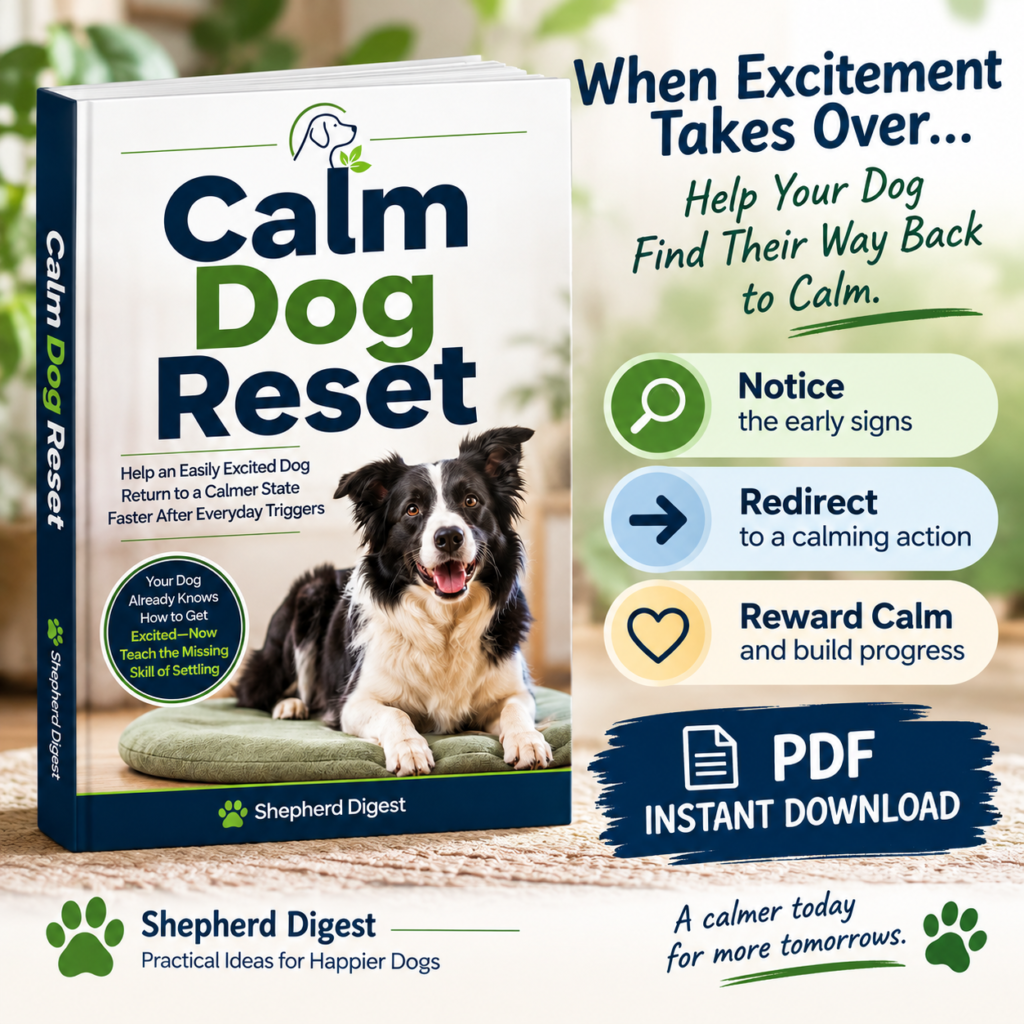
This idea became the basis for a simple method I call the Calm Dog Reset:
1. Notice
Watch for the earliest useful sign that excitement is beginning to rise.
Don’t wait until your dog is already barking, jumping, or racing around if you can catch the change sooner.
2. Redirect
Give your dog one simple, familiar action.
That might be sitting, lying down, moving to a familiar spot, or another easy behavior your dog already understands.
Don’t turn the moment into an obedience test.
You’re simply interrupting the climb and giving your dog a familiar direction to follow.
3. Reward Calm
Now watch carefully.
You’re looking for the first genuine movement toward settling.
Perhaps the body softens.
Movement slows.
The whining stops briefly.
Your dog looks away from the exciting trigger.
There’s a pause between barks.
Calmly reinforce that change.
Don’t wait for perfect relaxation before recognizing progress.
The first step down matters.
Think Recovery, Not Perfection
This is one of the biggest changes you can make in how you judge progress.
Suppose your dog still gets excited when someone comes to the door.
But instead of barking and pacing for five minutes, your dog responds to your redirect and begins settling after one minute.
That’s progress.
Perhaps barking still happens, but you can now get your dog’s attention earlier.
That’s progress too.
Ask yourself:
Did I notice the excitement sooner?
Could my dog still respond?
Did the intensity begin decreasing?
Did recovery happen faster?
Those questions can tell you much more than simply asking whether your dog became excited.
Calm Is the Comeback
A calm dog doesn’t have to be a dog without enthusiasm.
Your dog can still be playful.
Curious.
Energetic.
Excited to see someone they love.
The skill you’re building is the ability to return.
Excitement begins.
You notice.
You redirect.
Your dog starts coming back down.
And that movement toward calm becomes worth repeating.
That’s the comeback.
Want to Go Deeper?
I created Calm Dog Reset for dog owners who want a practical way to work on this exact problem.
The illustrated PDF guide takes you through the complete Notice → Redirect → Reward Calm method. It shows you how to recognize your dog’s excitement pattern, choose a useful calming action, catch the right moment to intervene, reward the first signs of settling, and gradually build faster recovery.
Calm Dog Reset is available now as an instant digital download from Shepherd Digest.
Your dog already knows how to get excited.
Now you can help teach the missing skill of settling again.
Shepherd Digest
Practical ideas for happier dogs
ShepherdDigest.com